
On this page
- Depth is one part of an insulation specification
- R-value and RSI describe the same property in different units
- Why there is no universal inches-to-R table
- How to read the product information in a quote
- Installed thickness and settled thickness
- Gaps, compression and framing affect the result
- A rebate target is not automatically a code requirement
- What to request after installation
- Frequently asked questions
Depth is one part of an insulation specification
R-value describes resistance to heat flow. Insulation depth is a physical measurement. They are related, but a depth measurement alone does not tell you the R-value without knowing the material, product and installation conditions. A quote that names a product and explains its coverage requirements is more useful than a promise to add the same number of inches to every attic.
For an existing Mississauga home, the starting condition also matters. A proposed finished level may combine an assessed existing layer with new material. Ask the contractor to separate the estimated existing value, the additional work and the intended finished result. This avoids confusing an added amount with a final target.
R-value and RSI describe the same property in different units
Both R-value and RSI express thermal resistance. RSI uses metric units. Conventional North American R-values use a different unit scale: an RSI value multiplied by approximately 5.678 gives the corresponding R-value. This is a unit conversion, not a method for estimating the value of unidentified insulation.
Higher thermal resistance means less heat flow through that material under the conditions of its rating. The complete ceiling or wall also contains framing, joints and other paths. A product’s nominal R-value does not by itself describe the effective performance of every part of the finished assembly.
Nor does R-value measure air leakage. An insulation layer and a continuous air barrier have different jobs. The air sealing guide explains why adding depth may leave another important issue unresolved.
Why there is no universal inches-to-R table
Different products have different thermal properties and installation requirements. Loose-fill cellulose, loose-fill fibreglass, batts and rigid boards should not all be read against a single depth rule. Even within a product family, the manufacturer’s coverage chart is the relevant reference for that named product and application.
For blown material, depth is considered with the required amount of material and the area covered. A visually fluffy layer is not enough to verify the specified installation. For batts, the rated dimensions and actual fit matter. Gaps, voids and compression should be assessed rather than hidden by a nominal number on a quote.
ENERGY STAR emphasizes the importance of product instructions and installation quality in its insulation-type guidance. Its material overview is general guidance; the Canadian product documentation and project requirements still need to be identified for your home.
How to read the product information in a quote
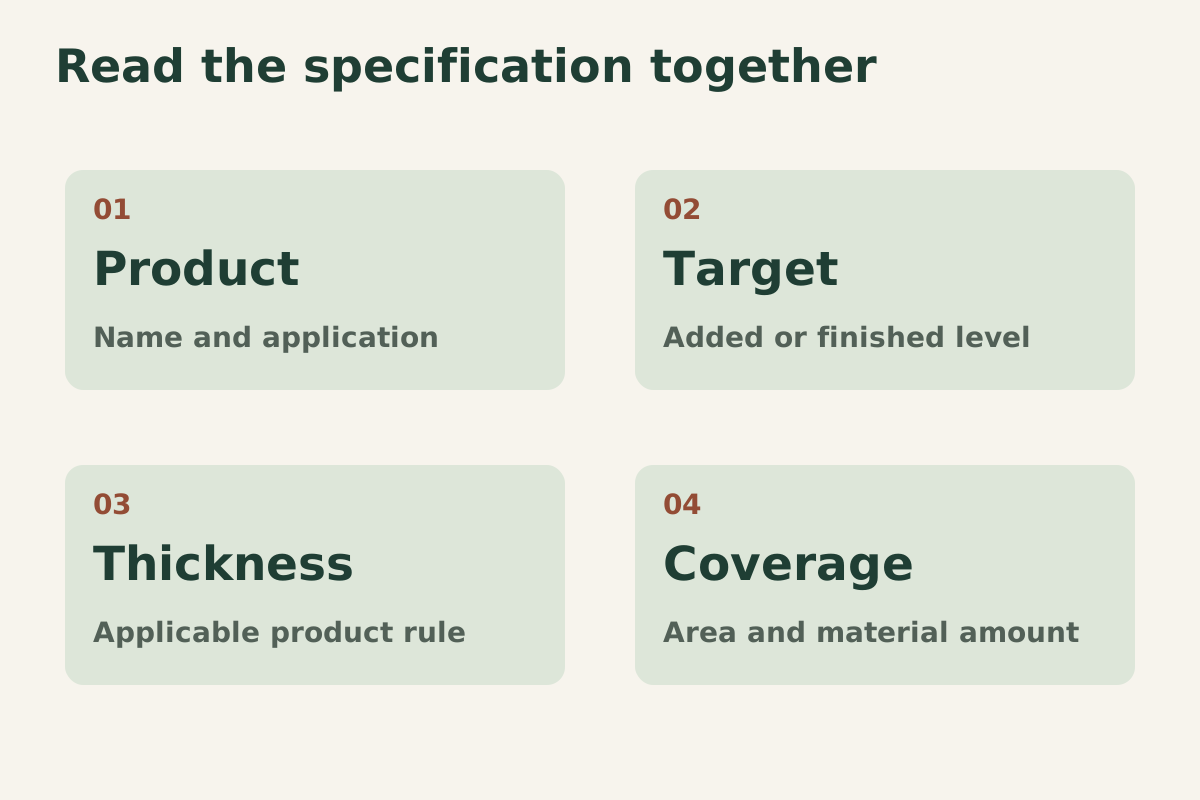
Ask for the exact product name and the applicable coverage or installation sheet. Then connect the quoted area and target to the relevant product requirements. You do not need to calculate the installation yourself to ask whether the proposal documents those connections.
| Detail | What it means for your comparison | Useful question |
|---|---|---|
| Product and application | Identifies what is being installed and where. | Is this the product intended for an open attic floor? |
| Intended R-value or RSI | Defines the stated thermal-resistance target. | Is the figure added insulation or the finished total? |
| Required thickness | Describes the applicable depth requirement. | Does the sheet distinguish installed and settled thickness? |
| Coverage or material quantity | Relates the material requirement to area. | How is the measured attic area used in the calculation? |
| Existing material allowance | Explains how retained insulation is treated. | What evidence supports the starting estimate? |
| Installation limitations | Identifies clearances, access and assembly constraints. | Which areas need a different detail or are excluded? |
Installed thickness and settled thickness
Where a product’s documentation specifies both initial installed thickness and a settled thickness, those terms should be kept distinct. A specification intended to account for settling should not be reduced to a photograph of the layer immediately after installation. Other products may use different instructions. Ask for the actual sheet instead of assuming a universal settling allowance.
For existing insulation, the contractor may need to account for uneven distribution, earlier disturbance and different materials in different locations. One depth reading beside the hatch does not represent every part of a complex attic. A split-level house or an addition can have separate spaces that need their own observations.
You do not need to compress, rake or move material to prepare an enquiry. An attic assessment can clarify what measurements and material identification are possible and which parts remain inaccessible.
Gaps, compression and framing affect the result
A continuous, properly installed layer is different from several isolated areas with the right depth. Missing coverage around edges or penetrations can create weak points. Batts that do not fit the cavity as intended can leave gaps, while material compressed below its specified thickness no longer represents the nominal installation shown on its label.
Framing also provides a path through the assembly. This is why an assembly-level discussion can be more useful than comparing only the highest product number. The materials guide explains how different product forms fit different spaces, including situations where continuous insulation forms part of a wider renovation.
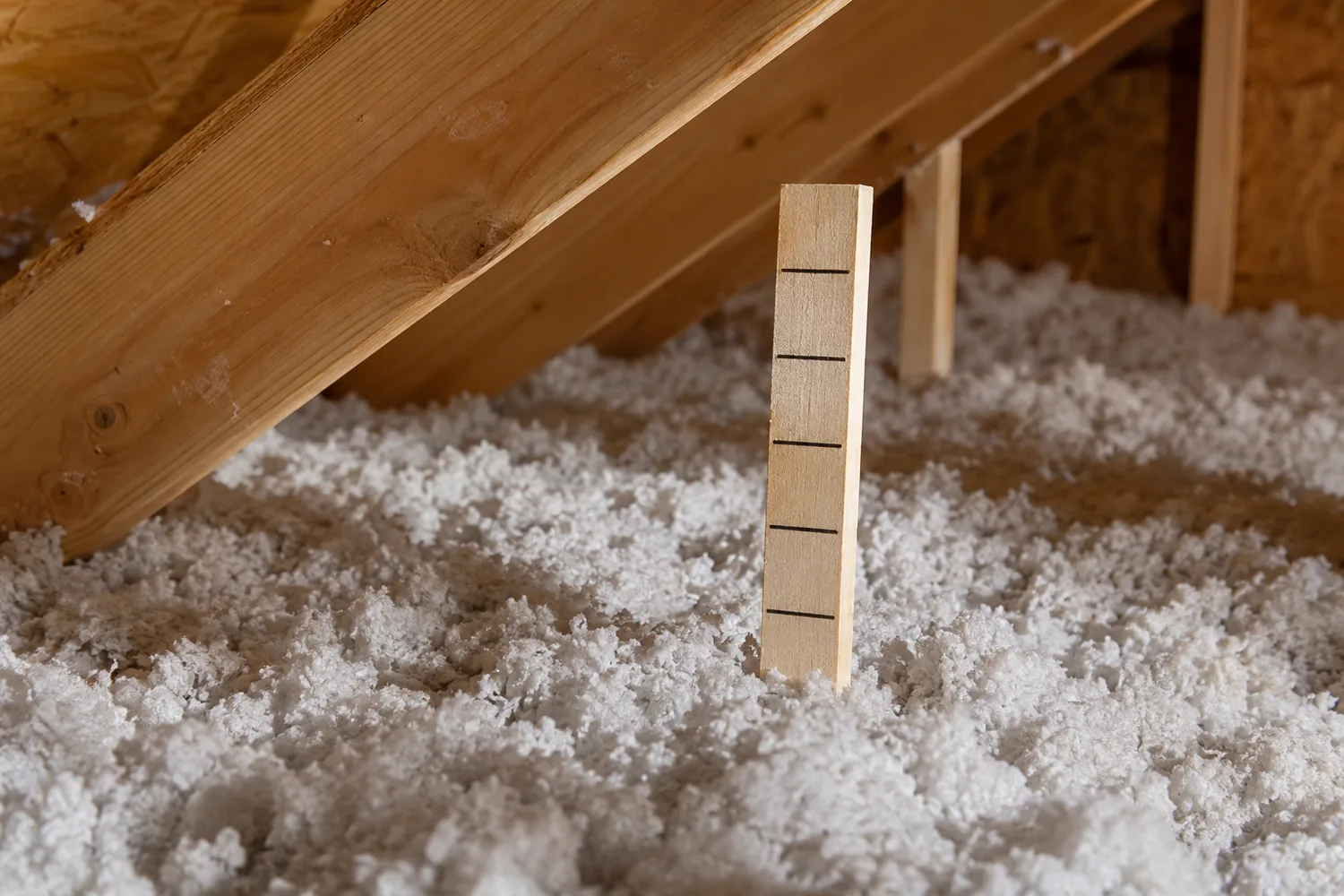
For a homeowner, the practical request is straightforward: ask how coverage, fit and difficult areas will be handled, and what the contractor can document at completion. A depth marker is an aid to checking the work, not a substitute for all the other requirements.
A rebate target is not automatically a code requirement
Three different figures can appear in the same discussion: a program’s eligibility target, a contractor’s proposed performance target and the requirement applicable to a permitted project. They serve different purposes. A rebate condition should be attributed to the specific program route and date; a legal requirement should be tied to the work and applicable rules.
The insulation rebate guide sets out the current program routes and links to their official requirements. It does not establish that every existing Mississauga attic is legally required to reach the same number. For a renovation with permit implications, confirm the assembly requirements with the appropriate designer, contractor and municipal process.
When a quote says “upgrade to current standard,” ask it to name the standard or target and explain its relevance. Written specificity is more helpful than a broad assurance.
What to request after installation
Ask the contractor which records are included before accepting the quote. Useful records can include the installed product, the treated area, the intended finished level, material quantity or coverage documentation where relevant, and photographs of accessible completed areas and preparation details.
The exact documentation depends on the scope and any program requirements. If a rebate route calls for particular invoices, photographs or assessments, establish that before work starts. Keep those records with the quotation and any prior attic information so a future contractor does not have to infer the whole history from appearance.
The 12-point quote checklist brings these details together with access, taxes, exclusions and rebate responsibilities.
Frequently asked questions
Not reliably without identifying the material and applicable product information. A single location may also miss uneven coverage or separate attic zones. Ask how the assessment establishes the starting condition.Can I determine the R-value by measuring the depth at the hatch?
The product must suit the assembly, available space, moisture design and installation method. Comparing only a number can miss those constraints. Ask why the proposed product fits the actual project.Is the highest R-value always the best product choice?
No universal settling rule should be applied across products. Use the named product’s instructions, including any distinction between installed and settled thickness.Do all loose-fill products settle in the same way?
They may, where the existing material is suitable and its contribution is reasonably assessed. The quote should explain the assumption. Read the guide to adding insulation over old material before treating an estimated starting value as certain.Can existing and new insulation contribute to a finished target?